Hey there! I’m a supplier of ball screw support bearings, and I often get asked about how to calculate the load-carrying capacity of these bearings. It’s a crucial topic because getting the load-carrying capacity right is essential for the smooth and efficient operation of any machine that uses ball screw support bearings. Ball Screw Support Bearings
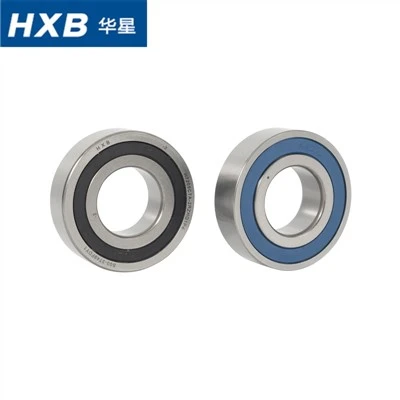
First off, let’s understand why load-carrying capacity is so important. Ball screw support bearings are used in a wide range of applications, from CNC machines to robotics. These bearings are responsible for supporting the ball screw and ensuring that it can move smoothly under the load. If the load-carrying capacity of the bearing is not sufficient, it can lead to premature failure, increased wear and tear, and even machine breakdown.
So, how do we calculate the load-carrying capacity of ball screw support bearings? Well, there are several factors to consider, and I’ll break them down for you.
1. Radial and Axial Loads
The first thing we need to look at is the type of loads the bearing will be subjected to. There are two main types of loads: radial and axial.
Radial loads are those that act perpendicular to the bearing’s axis. For example, in a machine where the ball screw is rotating horizontally, the weight of the components attached to the screw can create a radial load on the support bearings.
Axial loads, on the other hand, act parallel to the bearing’s axis. In a ball screw system, axial loads are typically generated by the forces required to move the load along the screw. This could be the force needed to lift a heavy object or move a worktable.
When calculating the load – carrying capacity, we need to determine both the radial and axial loads accurately. This can be done by analyzing the forces acting on the ball screw system. For simple applications, we can use basic physics formulas to calculate these loads. But for more complex systems, especially those with dynamic loads, it might be necessary to use computer – aided engineering (CAE) software.
2. Static and Dynamic Load Ratings
Bearings come with two important load ratings: static and dynamic.
The static load rating is the maximum load that a bearing can withstand when it is not rotating. It’s important to ensure that the static load on the bearing during operation does not exceed this rating. If it does, the internal structure of the bearing can be permanently damaged, leading to a significant reduction in its lifespan.
The dynamic load rating is the load that a bearing can withstand while it is rotating. It’s related to the bearing’s expected lifespan under a specific load. The general rule of thumb is that the higher the dynamic load rating, the longer the bearing will last under a given load.
Most bearing manufacturers, including us as a supplier, provide these load ratings in their product catalogs. You can find the static and dynamic load ratings for different types and sizes of ball screw support bearings easily.
3. Equivalent Load
In many real – world applications, the bearing is subjected to both radial and axial loads simultaneously. To calculate the load – carrying capacity accurately in such cases, we need to determine the equivalent load.
There are different formulas to calculate the equivalent load depending on the type of bearing and the ratio of radial to axial loads. For example, for a single – row angular contact ball bearing, the equivalent load formula is:
$P = XF_r+YF_a$
where $P$ is the equivalent load, $F_r$ is the radial load, $F_a$ is the axial load, and $X$ and $Y$ are factors that depend on the bearing’s internal design and the ratio of $F_a$ to the radial basic load rating $C_r$.
These factors can be obtained from bearing manufacturer data sheets. Once we have calculated the equivalent load, we can compare it with the dynamic load rating of the bearing to determine if the bearing is suitable for the application.
4. Service Life Calculation
After calculating the equivalent load, we can estimate the service life of the bearing. The service life of a bearing is usually defined as the number of revolutions or hours of operation that 90% of a group of identical bearings will complete before the first signs of fatigue failure occur.
The formula for calculating the basic rating life $L_{10}$ in millions of revolutions is:
$L_{10}=(\frac{C}{P})^p$
where $C$ is the dynamic load rating of the bearing, $P$ is the equivalent load, and $p$ is an exponent that depends on the type of bearing (for ball bearings, $p = 3$).
If you want to express the service life in hours, you can use the following formula:
$L_{h}=\frac{10^6L_{10}}{60n}$
where $n$ is the rotational speed of the bearing in revolutions per minute.
5. Safety Factors
In practical applications, it’s always a good idea to apply a safety factor. A safety factor takes into account various uncertainties such as variations in load, manufacturing tolerances, and operating conditions.
The safety factor is typically a number greater than 1. For applications where the load is relatively stable and the operating conditions are favorable, a safety factor of 1.2 – 1.5 might be sufficient. However, for applications with heavy shock loads, high – speed operation, or harsh environments, a safety factor of 2 or more may be required.
To use the safety factor, we multiply the calculated equivalent load by the safety factor. Then, we compare the resulting value with the dynamic load rating of the bearing to ensure that the bearing can handle the load.
Real – World Example
Let’s say we have a ball screw system in a CNC machine. The ball screw rotates at a speed of 1000 rpm, and we’ve calculated that the radial load $F_r$ on the support bearing is 500 N and the axial load $F_a$ is 300 N.
First, we look up the static and dynamic load ratings of the bearing we’re considering in our catalog. Let’s say the dynamic load rating $C$ is 2000 N, and the static load rating $C_0$ is 3000 N.
Next, we calculate the equivalent load. Assuming we’re using a single – row angular contact ball bearing and the factors $X = 0.56$ and $Y = 1.23$ based on the ratio of $F_a$ to $C_r$ (from the data sheet), the equivalent load $P$ is:
$P=XF_r + YF_a=0.56\times500+1.23\times300=280 + 369 = 649$ N
Then, we apply a safety factor of 1.5. The adjusted equivalent load $P_{adj}=1.5\times649 = 973.5$ N
Now, we calculate the basic rating life $L_{10}$ in millions of revolutions:
$L_{10}=(\frac{C}{P_{adj}})^3=(\frac{2000}{973.5})^3\approx8.5$ million revolutions
Converting this to hours:
$L_{h}=\frac{10^6\times8.5}{60\times1000}\approx141.7$ hours
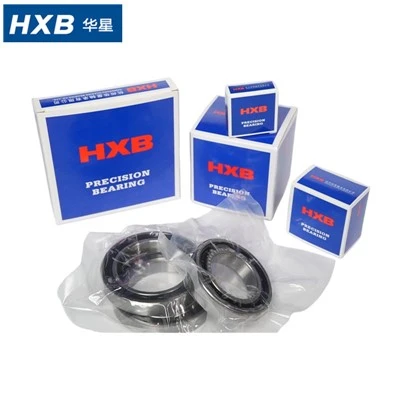
As a ball screw support bearings supplier, we understand that calculating the load – carrying capacity can be a bit daunting, especially for those who are not familiar with the technical details. That’s why we’re here to help! Our team of experts has years of experience in the field, and we can assist you in accurately calculating the load – carrying capacity for your specific application.
Servo Motor Bearings If you’re in the process of selecting ball screw support bearings for your machine, or if you’re experiencing problems with the current bearings in your system, don’t hesitate to reach out to us. We can provide you with detailed product information, help you with load – carrying capacity calculations, and offer solutions that are tailored to your needs. By choosing our bearings and working with our team, you can ensure that your machines run smoothly and efficiently with maximum reliability. Start a conversation with us today and let’s find the perfect ball screw support bearings for your application.
References
- Harris, T. A., & Kotzalas, M. N. (2007). Rolling Bearing Analysis, Fourth Edition. John Wiley & Sons.
- SKF Bearing Handbook. SKF Group.
- FAG Bearing Design Manual. Schaeffler Technologies AG & Co. KG.
Hangzhou Huaxing Kechuang Holding Group Co., Ltd.
Hangzhou Huaxing Kechuang Holding Group Co., Ltd. is one of the leading manufacturers and suppliers of ball screw support bearings in China, featured by quality products and good service. Please rest assured to buy bulk durable ball screw support bearings from our factory. Welcome to view our website for more information.
Address: No.553 Yingbin Road, Linping, Hangzhou, 311100, China
E-mail: wmb@huaxingbearing.com
WebSite: https://www.hxbbearing.com/
